Loading... Please wait...
Knowledge
Newsletter
History
A Brief History of Mosaics
|
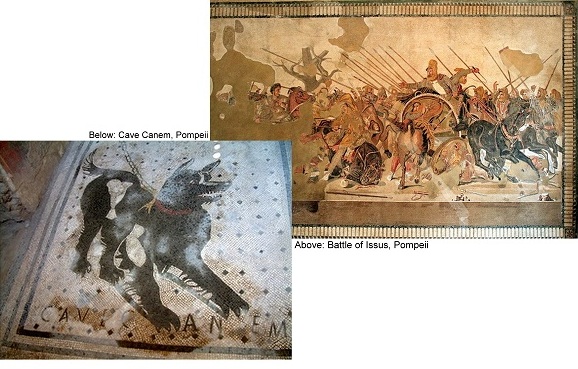
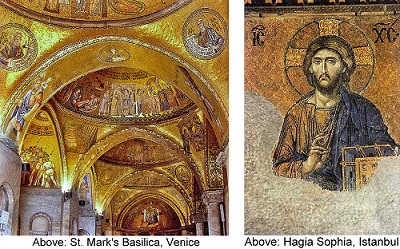
Mosaics have been called the eternal art form. The earliest applications are found in ancient pebble floor coverings and as embellishments to buildings in Sumeria where stones were pushed into clay walls to strengthen and adorn them. For the most part, mosaic as an art form was prominent during two principal periods in history. The first was during the the Greco-Roman period, which lasted from the reign of Alexander the Great which began in 336 BC to the fall of Rome in 476 AD. A famous example from this period is “The Battle of Issus” (2nd century BC) which depicts the famous battle of Alexander against Darius. Other examples include the classic “black and white” mosaics such as Pompeii’s Cave Canem and the polychromatics made during Hadrian’s reign.
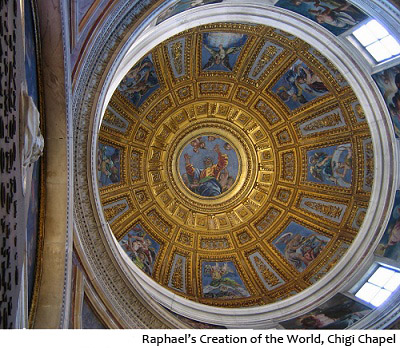
Beginning with the Renaissance period, mosaics began to fall out of fashion as fresco painting became a popular medium for artistic expression. Mosaics did not completely disappear - some of the most famous artisitic creations of the Renaissance period, including St. Peter's Basilica and Raphael's Creation of the World were executed with mosaics.
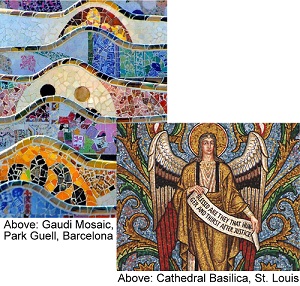
Over the next several centuries, mosaics faded into an "old-world" traditional art form. While their use declined, there are some dramatic examples from this period, including the Cathedral Basilica of St. Louis, the largest mosaic installation in the world and the works of Antoni Gaudi, which became to usher in a new age of modern mosaics.
During the late 20th century, mosaics enjoyed a rebirth as a popular modern art form. Going beyond the traditional small tesseare approach used to recreate an image or scene, mosaics became abstract. New materials, including ceramics, shells, mirrors and plate glass were used alongside traditional materials to create amazing works of art. A great starting point for seeing the range and beauty of today's mosaics is the website of Sonia King. History of SmaltiEven though some glass pieces were found in the mosaics of Mesopotamia during the fourth millennium B.C., the art of producing smalti seems to have been born in Egypt and then transferred in Persia, between the Assyrians and finally in Greece, where the Romans learned it. At the end of the twelfth century, the Venetians imported this technique from Constantinople where it had been undergoing technical improvements since the fourth century A.D. The methods for the production of the smalti have always been kept secret. During the 1800's, Lorenzo Radi improved the ancient tradition and Antonio Salviati, using Radi's experience, created mosaic laboratories and "The Venice and Murano Glass and Mosaic Company"(1872), so he could further improve the smalti and the technique of the gold production. Vincenzo Moretti also contributed by extending the already large range of colours in "The Venice and Murano Glass and Mosaic Company". In 1888 Angelo Orsoni became the owner of the factory founded by Giandomenico Facchina in Venice that produced smalti and golds for mosaics. In 1926 Ugo Donà took over all of Radi's tools and his workers and formed his own firm. Built on the legacy of Radi, the quality of Donà's products have always been recognized as superior in the mosaic community. At present Mosaici Donà Murano of Donà Stefano (Ugo Donà's grandson) is the only artisan firm which produces both smalti and golds for mosaics following the techniques of the past.
|